Altitude's Influence on Goal Scoring Patterns Across South America's Elevated Leagues
Written by Dana Russell · Aug 25, 2026
Altitude's Influence on Goal Scoring Patterns Across South America's Elevated Leagues
Stadiums perched at elevations above 2500 meters create distinct conditions that reshape how matches unfold in several South American domestic competitions, and data from league records shows measurable shifts in goal outputs when teams travel between low and high venues. Observers note that fixtures involving sides from Bolivia's top flight often produce different scoring rhythms compared with matches played nearer sea level in Argentina or Brazil, while researchers have tracked these variations through season-long statistics compiled by domestic federations.
Physiological Demands at Higher Elevations
Players experience reduced oxygen availability once they reach venues such as those in La Paz or Quito, which forces the body to adjust breathing rates and heart output during sustained running efforts. Studies conducted on endurance athletes indicate that aerobic capacity drops noticeably within the first 24 hours of arrival at these heights, although teams that train on site for several days display partial adaptation through increased red blood cell production. League schedules in 2026 place several early August rounds at these elevated sites, giving visiting squads limited preparation windows that compound the physical strain during the opening 30 minutes of play.
Ball Flight Characteristics Under Reduced Air Density
Thinner atmosphere alters projectile motion so that shots and crosses travel farther and with less drag than they would at lower elevations, and video analysis from CONMEBOL-sanctioned matches confirms that long-range attempts reach the target zone more frequently when games occur above 2800 meters. Goalkeepers face altered trajectories on set pieces because the ball dips less sharply, which changes how defenders position themselves inside the penalty area. Technical reports compiled by regional coaching associations highlight that teams adjust passing ranges upward in these conditions, favoring longer diagonals that exploit the extra carry the ball gains.
League Data on Goal Totals by Elevation
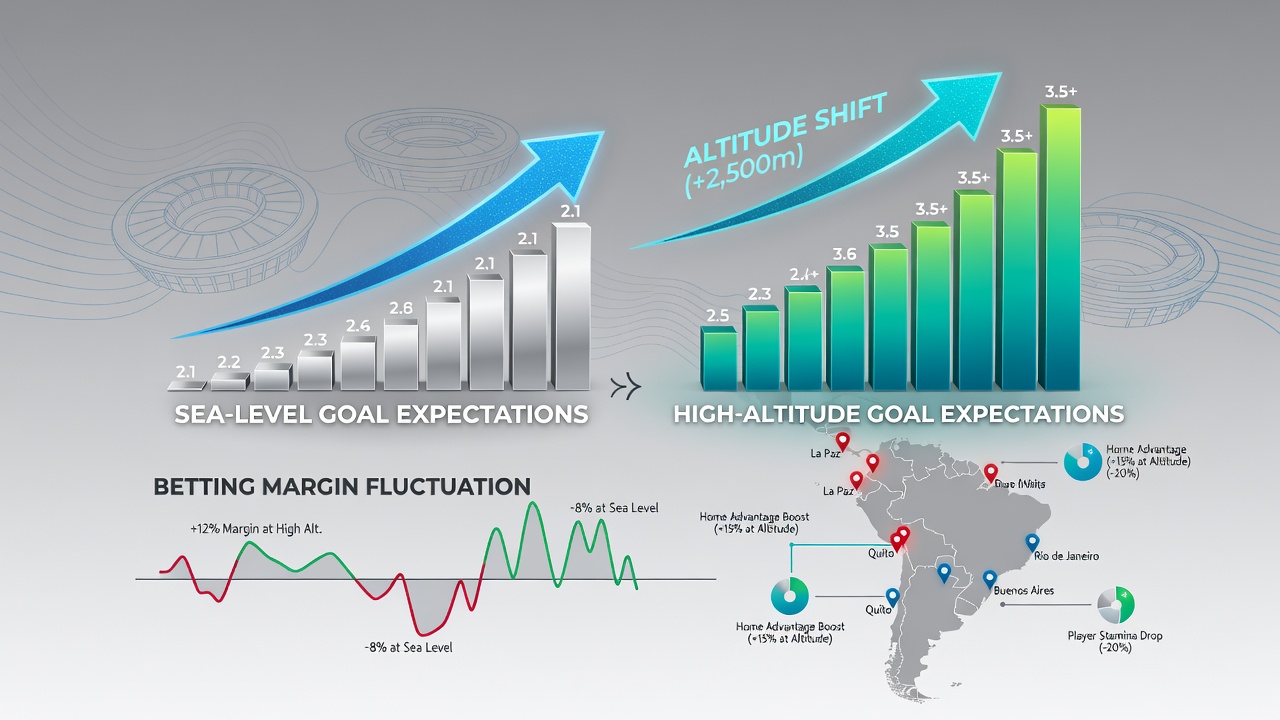
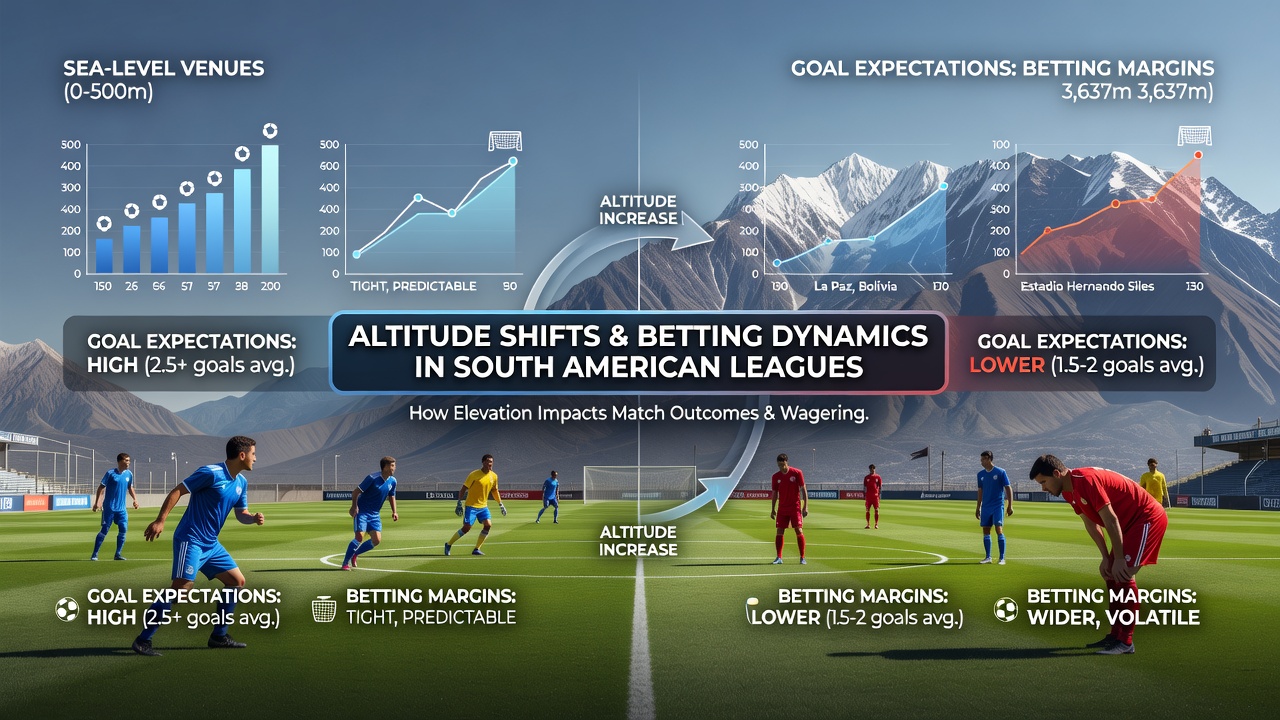
Seasonal aggregates released by Bolivian and Ecuadorian federations reveal that average goals per game rise modestly when both participants operate at their home altitude, whereas visiting teams from coastal regions record lower conversion rates on shots inside the box. One study released by sports science departments at South American universities compared 180 fixtures across five campaigns and found that matches hosted above 3000 meters produced 0.4 fewer total goals on average than equivalent pairings played below 500 meters, although the distribution skewed toward more long-range strikes rather than close-range finishes. These patterns hold across both league phases and cup ties that rotate venues each August.
Market Adjustments by Betting Operators
Bookmakers recalibrate total goals lines and handicap margins when high-altitude venues appear on the schedule, and historical pricing data shows wider spreads on over/under selections for La Paz home games compared with fixtures hosted in Montevideo. Operators incorporate travel fatigue and acclimatization windows into their models, which results in lower implied probabilities for visiting teams to keep clean sheets even when those sides rank highly in defensive metrics at sea level. Figures released by regional gaming associations indicate that liquidity on South American league accumulators concentrates more heavily on matches where elevation differentials exceed 2000 meters, prompting sharper line movements in the 48 hours before kickoff.
Examples from Recent Domestic Rounds
Take one August 2026 double-header in the Bolivian Primera División where a side traveling from Santa Cruz faced opponents based permanently at 3600 meters; match logs recorded 11 attempts from outside the box versus an average of six in their home fixtures. Another case involved an Ecuadorian club hosting a Peruvian visitor at Quito's stadium, where corner conversion rates climbed after the ball's flight path extended by roughly two meters on average, according to tracking data supplied to league analysts. These concrete instances illustrate how pre-match expectations shift once elevation enters the equation.
Implications for Accumulator Construction
Punters who build multi-leg bets across South American leagues often separate fixtures by elevation bracket to manage variance, and industry reports from gaming research centers in Australia and Canada note that blending high and low venues within the same slip reduces correlation risk compared with stacking several mountain matches together. Operators publish updated goal expectation models ahead of each round, allowing markets to reflect the latest acclimatization data collected from medical staff at participating clubs. Those models integrate GPS workload figures and oxygen saturation readings that teams share with medical partners under league privacy protocols.
Conclusion
Altitude remains a persistent variable that domestic federations and betting platforms continue to quantify through expanded data collection each season. As schedules rotate through elevated venues in August 2026 and beyond, both on-pitch tactics and market pricing reflect the measurable differences in ball behavior and player output that occur once elevation exceeds typical thresholds. Continued monitoring by academic and industry groups supplies fresh datasets that refine these calculations for future campaigns.